Why traditional wireless fails (and the smarter alternative)
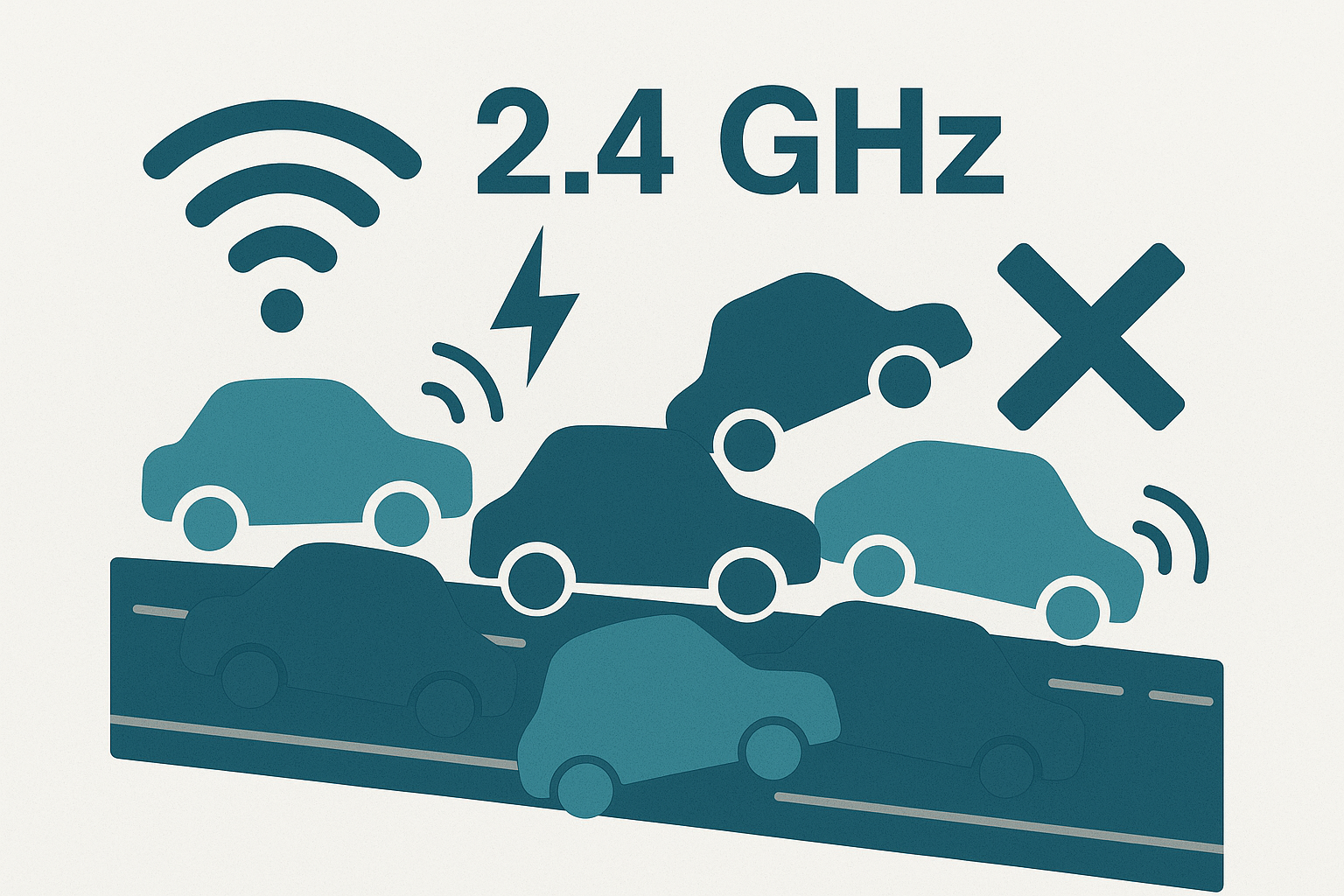
When it comes to wireless control in demanding environments – like building automation, lighting systems or industrial applications – the stakes are much higher than in your home network. Traditional wireless standards such as WiFi, Bluetooth, ZigBee and Thread all share a common vulnerability that makes them especially fragile in crowded frequency spaces like the 2.4 GHz band.
You can read more about this is our guide, How to Win at Wireless.
Conventional approaches to wireless communication – and their flaws
To maintain reliable communication, standard wireless systems often adopt methods such as:
- Listen-before-talk
The system “listens” to detect whether the channel is free before sending. But if there’s any activity, it waits. In busy environments, this often means stalling entirely. As soon as there is other activity on this channel it stops sending data and service could be lost. - Frequency agility (channel hopping on demand)
If the current channel is busy, switch to another channel with less interference. The problem? When switching, connections often break temporarily, especially in larger networks. - Frequency hopping (predefined sequences)
The transmitter and receiver hop together across a fixed list of frequencies to avoid persistent interference on any one channel. This helps, but it’s not adaptive – if interference patterns change, the predefined sequence may fail. - Adaptive frequency hopping (AFH)
The system measures interference and excludes “bad” channels dynamically. However, AFH still avoids those channels entirely – even if they sometimes become free again. It also doesn’t necessarily re-integrate “recovered” channels back into the usable pool.
All of these methods – while improvements over static single-channel usage – share a key limitation: they are reactive or rigid. In effect, they either limit themselves to supposedly “safe” channels or stop altogether when conditions worsen.
“The major problem … is that they are too rigid and do not make use of frequency space when it is available. At best they restrict themselves to channels where no interference has been detected, ignoring channels which become free – and at worst they simply stop communicating altogether.”
From ‘How to Win at Wireless – The Insider’s Guide’
If your application is mission-critical, this kind of behavior can’t fly. You need something smarter.
Enter Cognitive Coexistence
Rather than selecting a single channel and trying to defend it, LumenRadio’s Cognitive Coexistence takes a more fluid, dynamic approach:
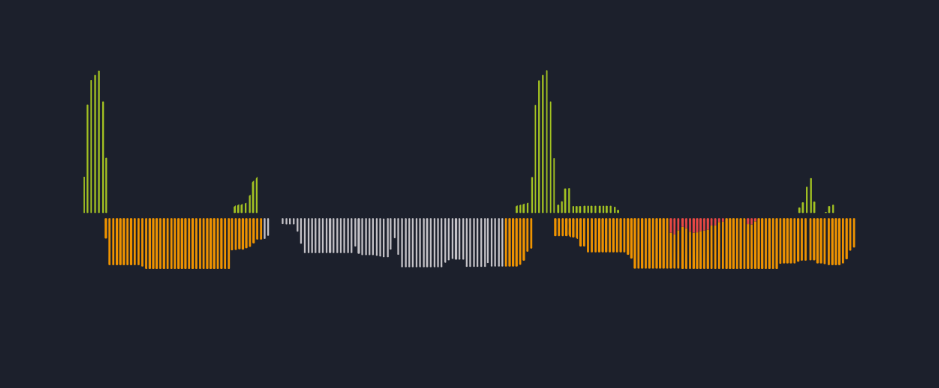
- It constantly measures the quality and availability of channels (every ~10 ms)
- It identifies and uses gaps in the 2.4 GHz spectrum instead of excluding sections of it outright
- It adapts in real time, hopping to optimal frequencies as conditions change

Unlike AFH which blocks channels and sticks to that decision indefinitely, Cognitive Coexistence can replace blocked channels in its sequence to keep transmitter and receiver perfectly synchronized – even as the set of usable channels shifts. In other words, it doesn’t break the channel sequence and avoids data loss:
“When standard AFH cycles through its static list of frequencies, it blocks a channel where there is already noise. Cognitive Coexistence gets around this issue by replacing the blocked channel with a good channel on the list and ensures that the transmitter and receiver remain in sync.”
From ‘How to Win at Wireless – The Insider’s Guide’
Why this matters (and where it shines)
For scenarios where failure is not an option – such as professional lighting, building controls and industrial automation – Cognitive Coexistence isn’t just elegant, it’s essential. It coexists with other radio traffic in the narrow 2.4 GHz band without interfering, while maintaining robust connectivity itself.
Typical application areas include:

- Entertainment and stage lighting
- Commercial and office lighting
- Street and outdoor lighting
- HVAC and climate control
- Industrial monitoring and control
Thanks to this approach, you get wireless control that rivals the reliability of wired systems, but without the cost, complexity and disruption of cabling.
How to Win at Wireless
Discover why LumenRadio has become the technology of choice for wireless communication that matters.